Secure agents. Safer transactions.
AI has wallets.GARD decideswhen they can spend.
The transaction protection layer
for autonomous money.
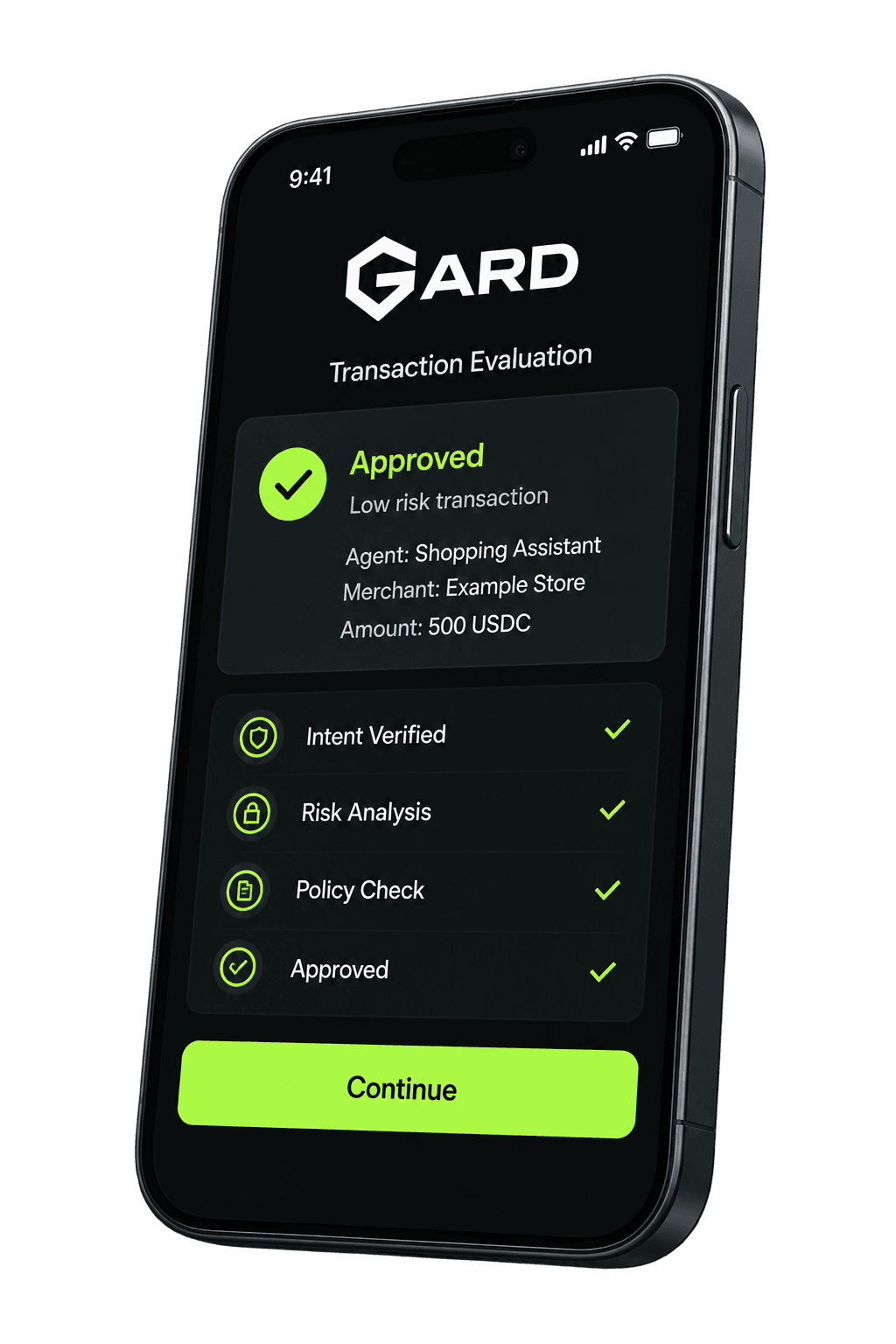
Helps preventmalicious transactions
Designed to evaluatein real time with AI
More controlfor a more open economy
How it works
Smart protection for
the agent economy.
GARD is designed to analyze transaction context before execution so autonomous agents can operate under explicit rules and human-defined policies.
1. Analyze
GARD receives the proposed transaction, intent, recipient, asset, amount, and relevant context.
2. Decide
Risk intelligence and policy rules evaluate whether the transaction fits its intended purpose.
3. Approve or Block
GARD returns ALLOW, REVIEW, or BLOCK.
4. Execute
Only transactions permitted by the application's policy continue toward execution.
Evaluation pipeline
Designed for real-time transaction intelligence.
GARD is being designed as a decision layer between autonomous software and money movement. Each request is intended to pass through intent, risk, and policy evaluation before a decision is returned.
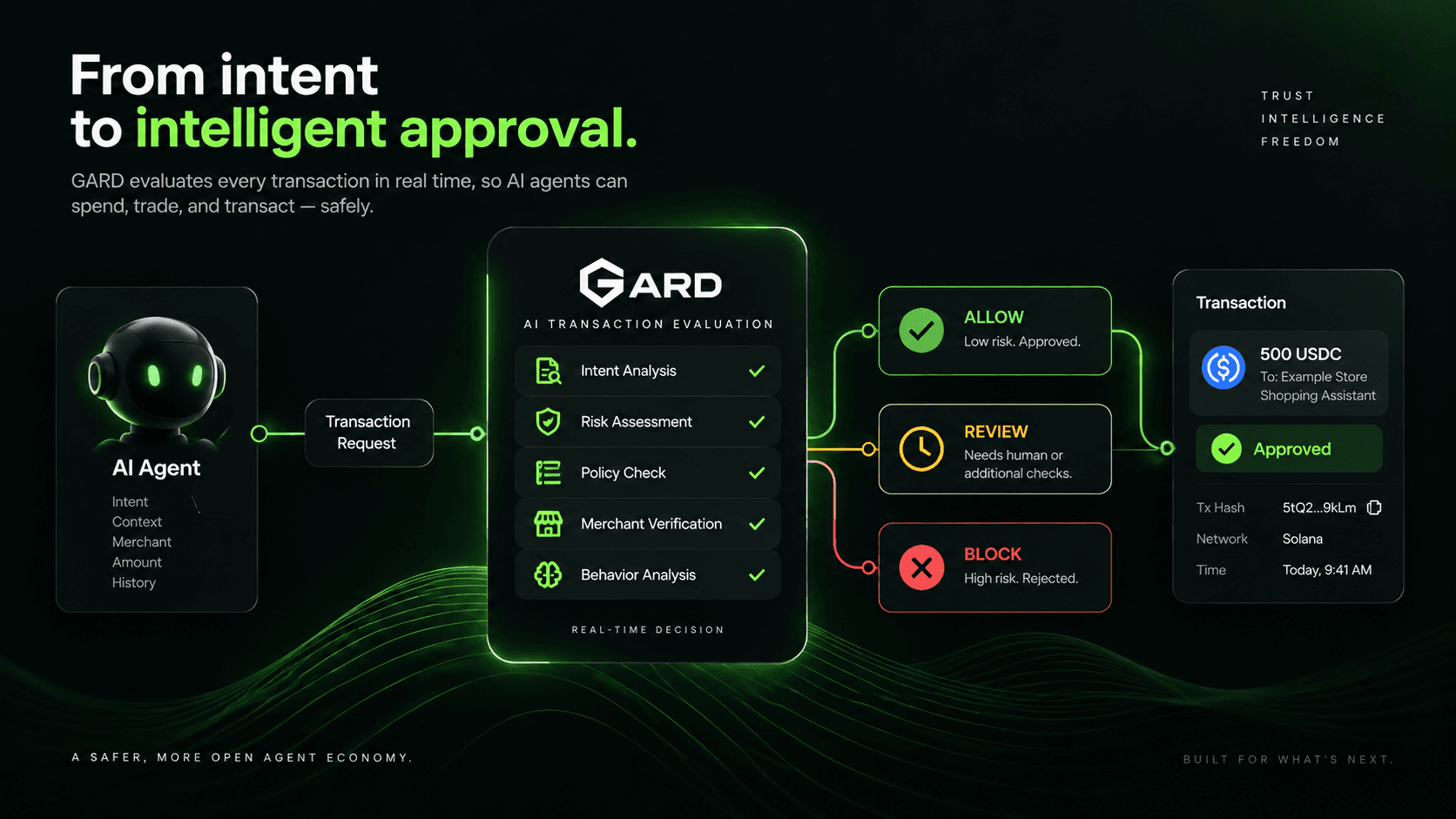
Intent analysis
What is the agent trying to accomplish?
Risk assessment
Does the transaction context look normal?
Policy check
Does it satisfy explicit spending rules?
Merchant verification
What is known about the recipient?
Behavior analysis
Does it deviate from expected activity?
Built for a more open economy
Security without
limits.
GARD is designed to provide transaction controls that can travel across wallets, applications, and autonomous agents.
Works across wallets, apps, and agents
Designed to integrate with any wallet, application, or agent workflow.
Real-time transaction evaluation
Combines transaction context, policy, and risk signals before execution.
Designed for individuals and developers
Simple to use. Structured interfaces for builders.
Explicit policy enforcement
Limits, allowlists, and review thresholds defined by you.
Auditable decision history
Each decision is intended to be recorded along with its reasons.
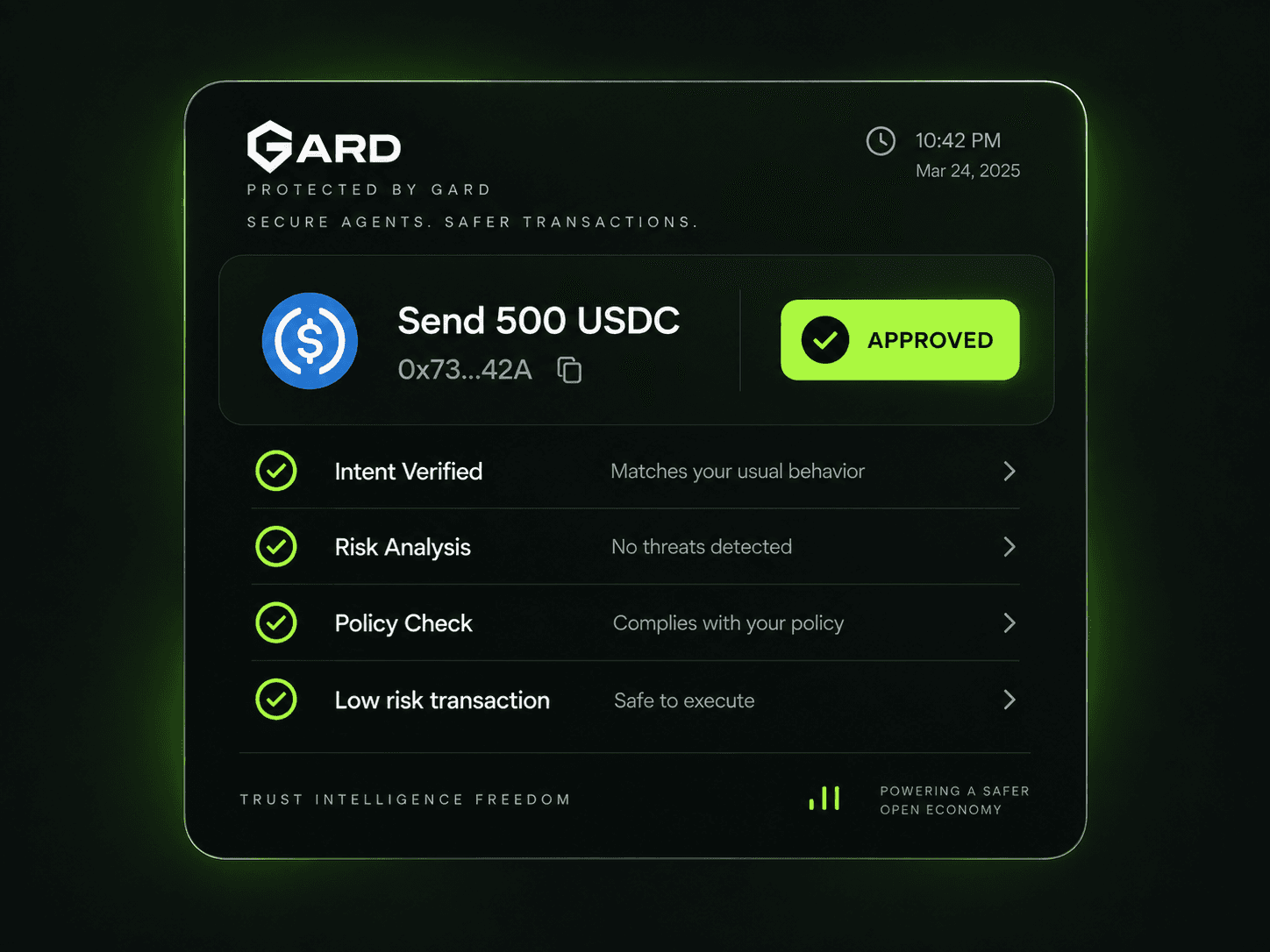
Protected transaction
What a GARD-protected transaction looks like.
Before funds move, the transaction request passes through GARD. The application receives a decision and the reasons for it, then chooses whether to execute.
Intent verification
Checks whether the transaction matches the stated purpose.
Risk evaluation
Considers recipient, amount, and behavioral context.
Policy evaluation
Applies the limits and rules the application has defined.
ALLOW / REVIEW / BLOCK
Returns a structured decision the application can act on.
Decision history
Keeps a record of each decision and the reasons behind it.
GARD provides policy and risk evaluation. A GARD decision is not insurance or a guarantee against loss.
The token
$GARD powers
the GARD ecosystem.
$GARD is intended to coordinate access and participation around the protocol. USDC moves the value; $GARD has separate, planned utility. None of the utility below is live today.

Intended utility — planned
- Stake $GARD for access tiers
- Stake $GARD for lower protocol and API fees
- Unlock higher API and policy limits
- Future security bonding for ecosystem operators
- Future ecosystem participation
Planned and proposed utility only. Subject to change.
Developers
One decision before execution.
Submit a proposed transaction and receive a structured decision your application can act on. The interface below is planned.
Example API response
IllustrativePOST /v1/evaluate{
"decision": "ALLOW",
"confidence": 0.96
}